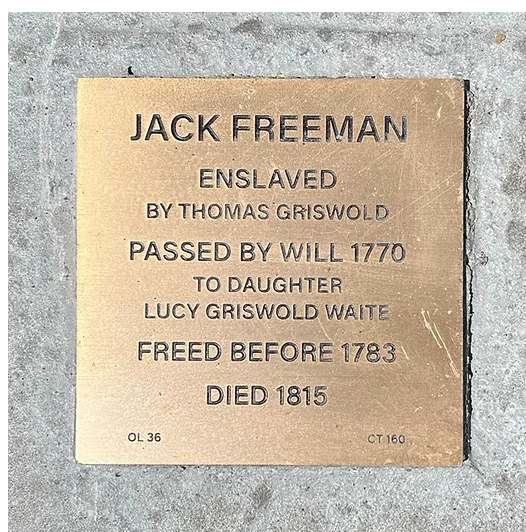
Jack lived enslaved in Black Hall to Thomas Griswold (1718-1770) who, like his brother Capt. Matthew Griswold Esq., inherited extensive land in 1764 from their father Judge John Griswold. When Thomas died in 1770, Jack passed by will to his daughter Lucy Griswold Waite (1745-1800), wife of Richard Waite Jr. (1739-1810), and for thirteen years Jack labored on their Black Hall farm. Waite in 1781 emancipated, “or made free,” his “Negro manservant or Slave Jack Agreeable to an Act of the General Assembly of the State of Connecticut Passed in their Sessions October 1777.”
Property records state that in 1783 “Jack a Negro man (formerly the Servant of Majr Richard Waite junr of sd Lyme but by sd Waite is made free)” bought half an acre “on the northeasterly line of Black Hall” for three pounds from Bridgham Lay (1739-1820). Jack appears to have been ill that year as Dr. Samuel Mather (1742-1834) billed “Jack, Negro” for four visits in 1783 at the house of Capt. Lee Lay (1746-1813). Lee Lay had married in 1771 Thomas Griswold’s youngest daughter Louisa Griswold Lay (1751-1813), who inherited her father’s Black Hall dwelling house. Census counts in 1790 and 1800 show that Capt. Lee Lay owned one unnamed slave.